The new premises are open, with the first admissions on 5th July 2005

THANK YOU all very much for the advice, contacts and funds

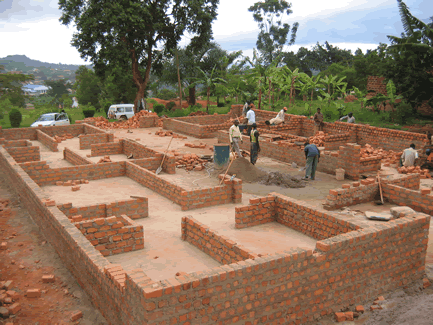
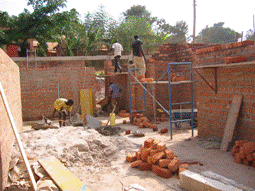
We will develop a full photo gallery (above) but for now please view the following. You can also view the Plan/Design by EMIUSA (see above link) or Tour Hope Clinic for pictures of the work in progress. You can Tour the site Construction of the Clinic

The interior of the clinic, has been finished to the highest quality to ease the work of our staff and improve the care normally available to our catchment of patients. The Reception for out-patients is adjacent to the laboratory and two consultation rooms. On this side of the building is a dispensary and two other rooms for private counselling.

The admissions side of the building has been partly furnished - this is the most modern ward with adjustable beds and screens (courtesy of Rotary clubs in Cleeve Vale and Makindye). We have a separate small ward for children, two delivery rooms and a women's ward - a total of 10 beds. In patients benefit from hot water, internal plumbing and showers as well as a power back-up system to safeguard mothers delivering at night.

The delivery rooms are planned to give mothers to room to move about during labour. This is desired and leads many mothers to deliver at home, even after clinic-based ANC visits. The delivery bed allows prone deliveries, stirrups for after-care but also a normal bed for resting during the first stage. Each of our consultation and treatment rooms have a basin with hot and cold water and windows with mosquito screens.

The new medical centre has been developed in response to requests from the community for an enlarged facility and with better interior standards for our medical staff and patients, particularly expectant mothers.


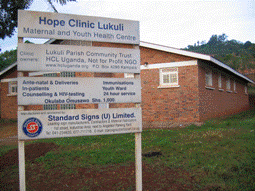
The Hope Clinic Lukuli Maternal and Youth Health Centre

The major changes that the new facilities has brought to our staff and the patients include more space and hence time to tend to patients with a wider range of services. Patient numbers grew from 350 to 500 a month in just 9 months. We now offer:

   
  • Free child immunisation on Mondays supported by Kampala City Council, alongside child development monitoring - over 100 children a week in April;
  • HIV counselling (VCT) can be provided throughout the week in the two counselling rooms, with Saturday as a specific day with an additional counsellor on site;
  • Formalised nutrition guidance for babies/ mothers and children during the Thursday ante-natal classes - over 60 mothers a month, with many attending second and third check-ups before their due date;
  • Hosting visits by the Straight Talk Foundation including circulation of their monthly publications Straight Talk and Young Talk;
   
  • Managing the PMTCT (preventing mother to child transmission) programmes by counselling and testing all new ante-natal attendees and providing the drug Nevirapine to positive mothers and their new-borns;
 
  • A comprehensive General Practice service involving a Doctor, Registered Nurses and Midwives as well as on site laboratory - seeing over 500 out-patients a month;
  • The capacity to allow admissions of patients to three wards (general, female/ maternity and childrens) for management of fevers, infections and observation of critical cases;


Additional services introduced in 2006 include:

  • Agreement with the Joint Clinical Research Centre to hold paediatric clinics, host a mobile pharmacy to dispense ARTs and additional laboratory testing services for people living with HIV/AIDS;
  • Providing awareness workshops to parents and school children on self-worth and responsibilities as tools to reduce the transmission of HIV. The porgramme is called Stay Alive is implemented by Reach the Children. This builds on the clinic's training for staff of Aggreko, the power generation company;
  • Creation of a Youth Centre based on the LifeSkills (PHSE) objectives of Straight Talk and providing a forum for the pre-counselling and post-test youth to meet.
These services will be delivered in a modern, high quality environment with an electric inverter power storage system to enable safe night-time deliveries, protection of in-patients and maternity cases/ babies from malaria/ mosquitoes and the sanitation and internal plumbing for hygienic treatment and for mothers in labour.