You are here » Home » Telling Our Story
Serving the Community - Our own NGO
Hope Clinic, a health unit started by a community of friends
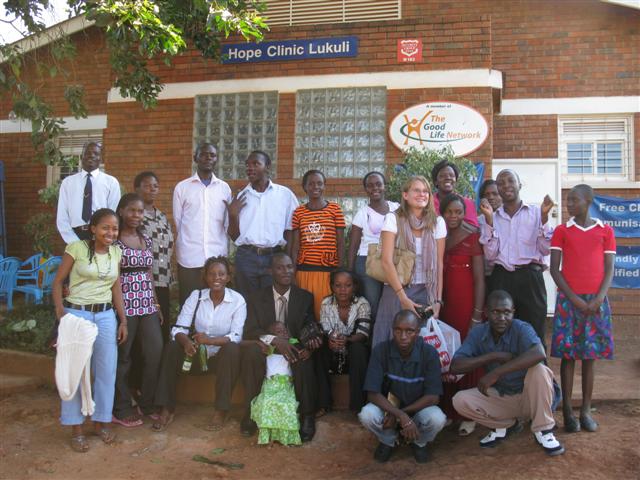
Photo: Hope Clinic Lukuli
The dedicated Hope Clinic staff
“Hope Clinic needed to exist, to serve the community.
We worked with government and donors to bring USAID services to the
community that needed it. "Adalina Lubogo, co-Chair.
The Government health system is overrun and under-equipped. The
medics at those sites are not motivated to work, they have few of the
necessary drugs and little supportive supervision. The nearest
government staffed sites are 3 miles away - they are not accessible at
night time and hence not for children with night-time fevers or women
who have started to deliver their babies. The community need affordable
access to fever management, safe pregnancies and HIV testing, care and
support. The population are self-employed, often reliant on selling
surplus crops from a smallholding of land. The population of 60,000
people living within 2 miles of a self-employed midwife need more
services, advice on family planning, guidance on HIV prevention and
prompt and accurate diagnosis of fevers.
Hope Clinic started with one dedicated midwife who just needed
guidance and support to work with government and donors to deliver
quality healthcare efficiently - and hence at fair prices. The founders
are not medics and bring business and marketing skills to support their
neighbours and help their community. In nine years, Hope Clinic has
expanded services to include family planning, admissions for fevers,
child and maternal health and public health education on nutrition,
sanitation and improving income in poor households. The USAID support
began with funding to Straight Talk publications to inform the youth;
it funded the AIDS Information Centre counselling for VCT and PMTCT; it
funded the family planning commodities; it funded the mosquito nets the
pregnant women use.
Hope Clinic’s original sole midwife helped 50
people and delivered 5 babies a month in 2000. There
was no microscope and no access to child vaccinations
or HIV services. In 2008, recorded HIV prevalence was
over 15%. USAID, through PEPFAR-funded programmes and
the Malaria Initiative, have supported an indigenous
NGO to grow steadily as the community better understood
its rights to access health services and chose to utilise
those services. USAID’s help to Hope Clinic allows
free family planning, free child immunisation and free
HIV services. Other services have fair prices through
collaboration with the District Health Services. Hope
Clinic serves over 1,000 out-patients a month. In the
past year, 5,000 people had HIV tests - and all 46 HIV
positive pregnancies had negative babies.
Back to Top ^
|







 Agriculture








 Asia
Asia








 RSS Feed for Recent Telling Our Story Updates


